The rewards were there.
The understanding wasn't.
I designed the Education Centre for TD's Loyalty & Rewards mobile app — a centralized hub to help cardholders understand what they have, what it's worth, and what to do with it. Over 65% of cardholders engaged with it at launch, cardholder comprehension improved, and support calls about credit card rewards dropped by over 40% within the first two months.
65%+
Of cardholders began actively engaging with the Education Centre after launch
40%+
Drop in inbound agent calls about credit card rewards within the first two months
↑
Cardholder comprehension and satisfaction with the rewards experience
01 — Context
Part of a bigger bet on loyalty.
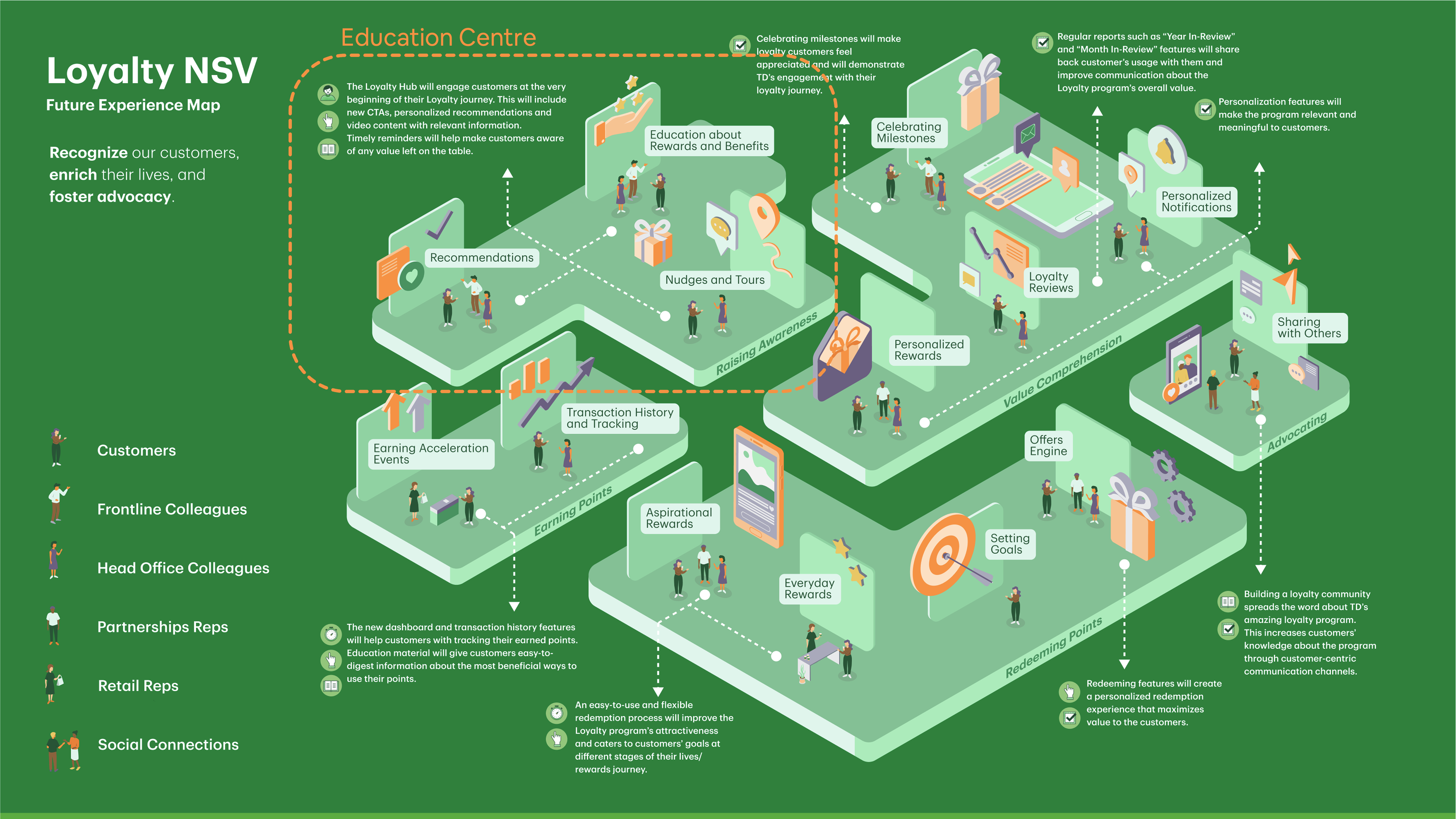
TD's Loyalty & Rewards program spans millions of cardholders across multiple credit card tiers — each with different earning rates, redemption options, and partner integrations. It's a high-value program with significant complexity.
The North Star Vision driving this work was clear: transform users from passive participants into active advocates. The Education Centre was the first step — the foundation that everything else in the loyalty experience would reference.
My role was to take early research and abstract product thinking and translate it into a concrete, production-ready experience. That meant:
- Defining how and where users enter the Education Centre across the app
- Structuring the information architecture around user intent, not internal program logic
- Aligning product, engineering, design systems, and legal around a shared IA model
- Designing fallback states and edge cases for multi-API dependencies
- Shipping production-ready specs through design review, QA, and implementation
02 — Problem
High perceived value. Low understood value.
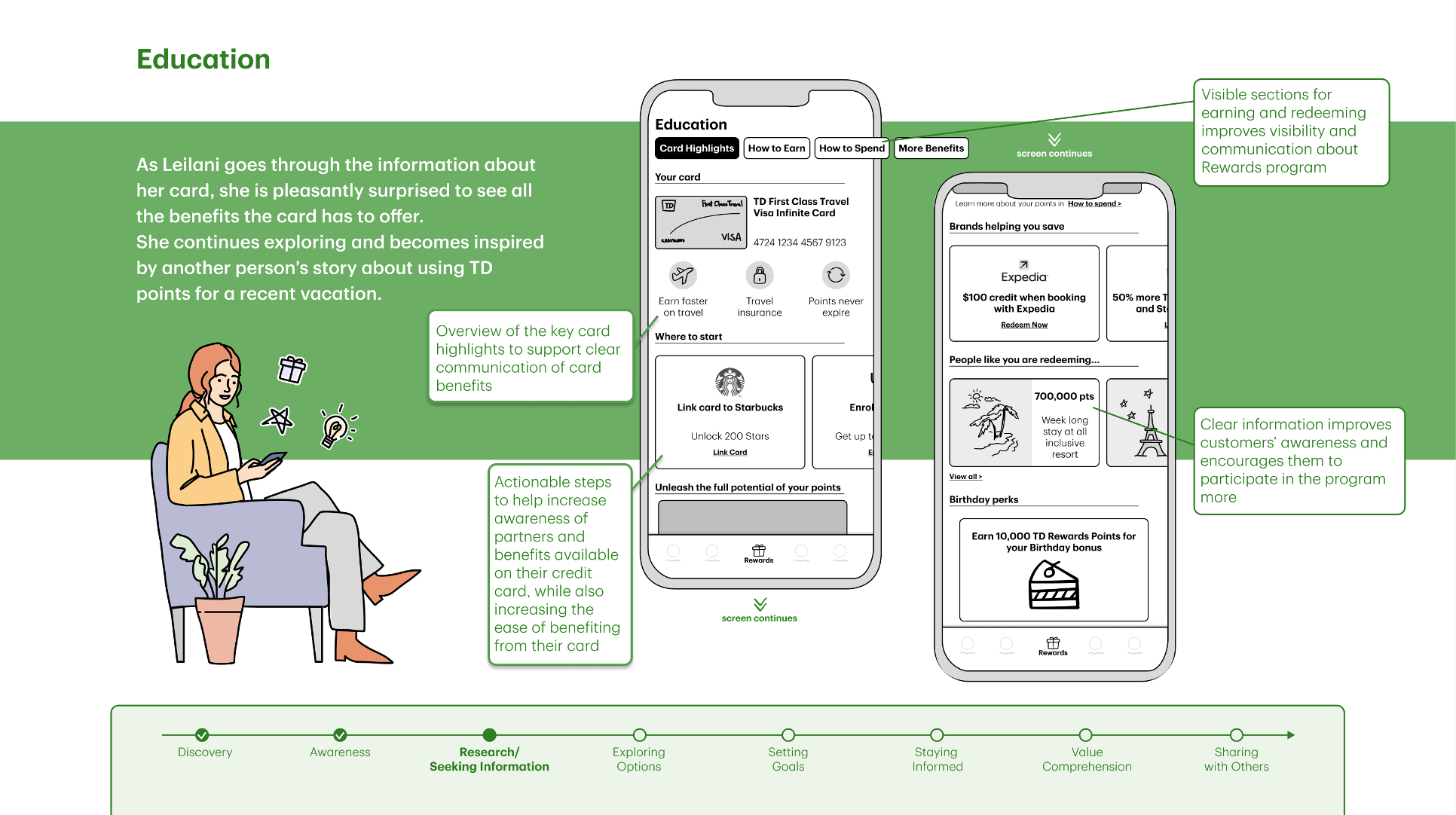
Users knew they had a TD credit card. Most knew they earned points. Very few could explain what those points were worth, how to earn more, or what they could actually do with them.
The gap wasn't in the product's value — it was in the product's legibility. The rewards system was rich but opaque. Users who didn't understand it didn't engage with it. And users who didn't engage with it eventually churned.
"I know I have points but I never know how much or what to do with them."
— Research participant, TD cardholder
Research showed three specific knowledge gaps driving disengagement:
Users couldn't see their value clearly
Points balance and card benefits were buried across multiple screens. There was no single moment of "here's what you have."
Earning and redemption felt like a mystery
Users knew spending earned points, but had no model for how, at what rate, or through which partners they could accelerate earning.
Dense text wasn't working
Existing program documentation was accurate but unusable in a mobile context. Users needed visual, scannable, action-oriented content.
03 — Insights
Three findings that shaped everything.
Each insight from research had a direct design implication. The Education Centre wasn't built around features — it was built around what users needed to understand before they could act.
01
Users wanted clear visibility into their cards and points — in one place.
Implication: Lead with the card and its current points balance before any educational content. Don't make users hunt for their own value.
02
Users needed simpler explanations of earning and redemption — not more information.
Implication: Structure content around three distinct user intents (Benefits, Earn, Redeem) rather than the program's internal taxonomy.
03
Users responded significantly better to visual, actionable content than to dense copy.
Implication: Every section needs a clear CTA that moves users forward. Education is only valuable if it leads to action.
04 — Design decisions
Three decisions.
Each research-backed.
The design decisions weren't arbitrary — each was a direct response to a specific insight. Documenting the rationale made stakeholder alignment significantly faster and created a traceable handoff for engineering.
01
Entry point strategy
Users arrive at the rewards section from different contexts — some are browsing rewards broadly, others are reviewing a specific credit card. A single entry point in one location would miss the majority of discovery moments. I introduced a permanent entry point on the Rewards landing page, a contextual entry from the credit card account screen, and a temporary "New for You" awareness card to drive initial adoption. Each entry point meets users where they already are rather than redirecting them somewhere new.
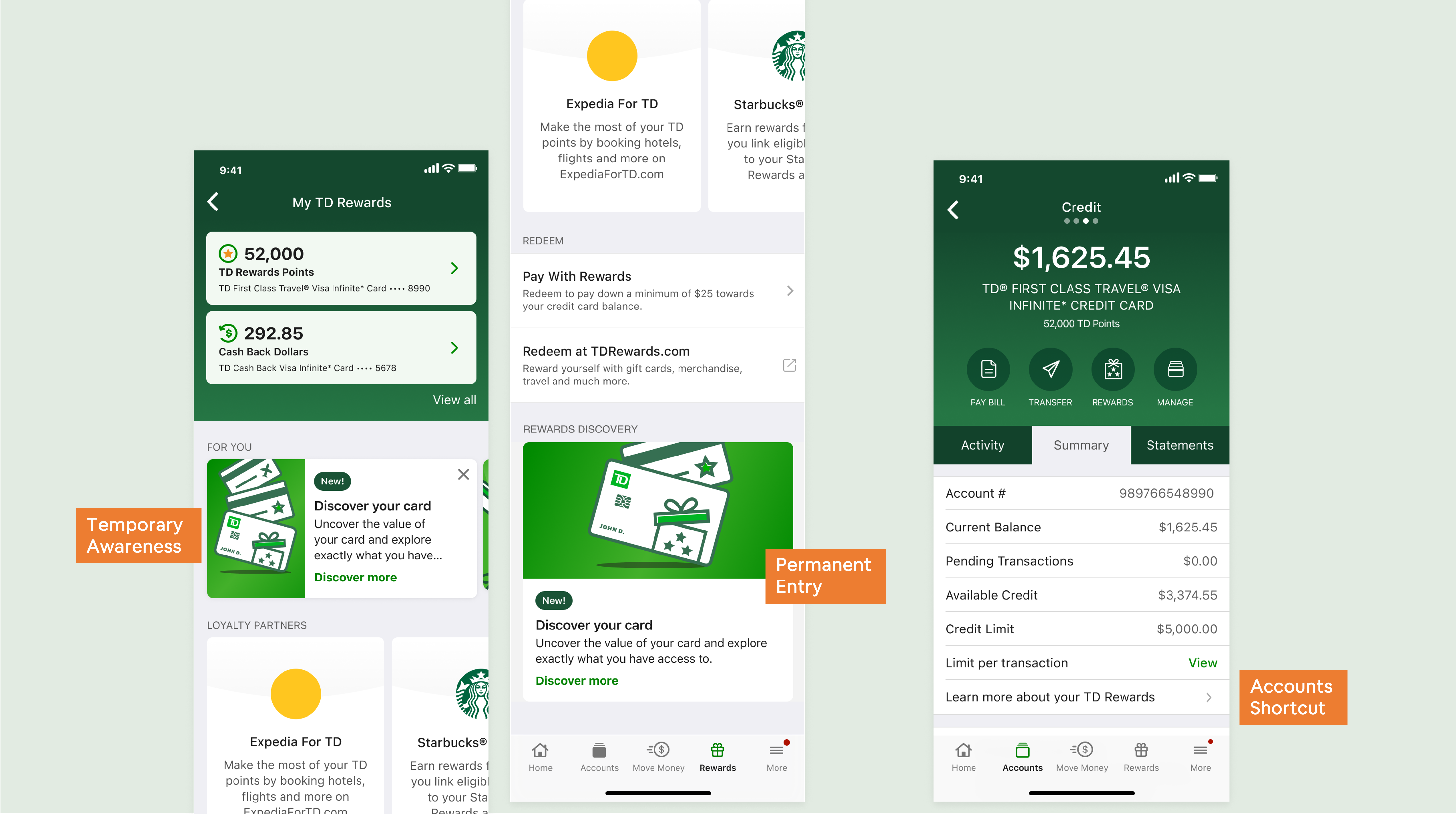
Rejected: A single entry point on the Rewards home only. This would require users to navigate to the Rewards section before they could access the Education Centre — missing the high-intent moment when a user is already looking at their credit card account.
02
Value visibility
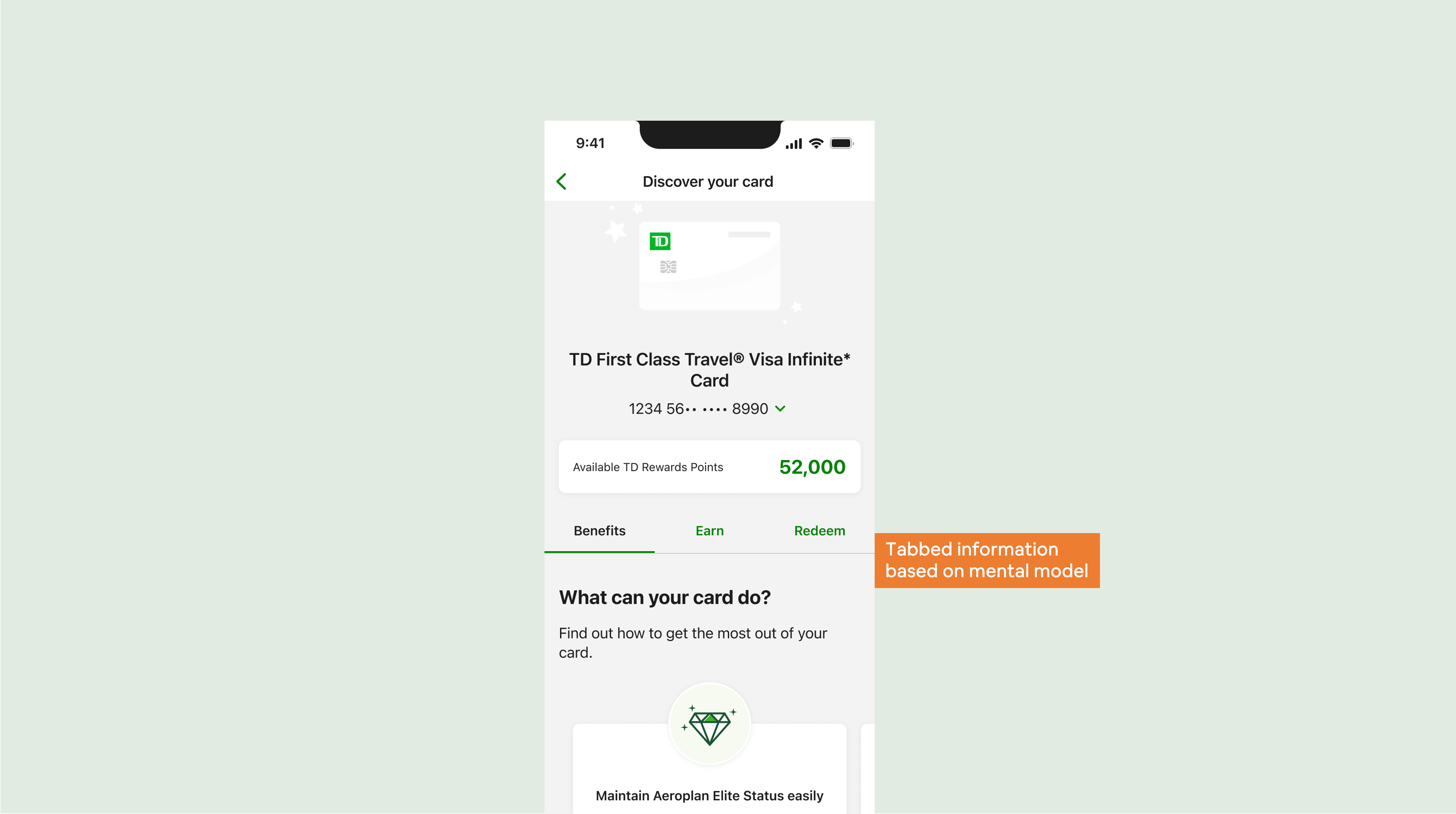
The Education Centre opens with the user's card and current points balance front and centre — before any educational content. This is intentional. Users told us they felt disconnected from their rewards because they never had a clear sense of what they had. Anchoring the experience in their actual balance transforms education from abstract to personal: "here's what you have, and here's how to make the most of it." For multi-card users, card-switching is available inline — no navigation required to understand their full value.
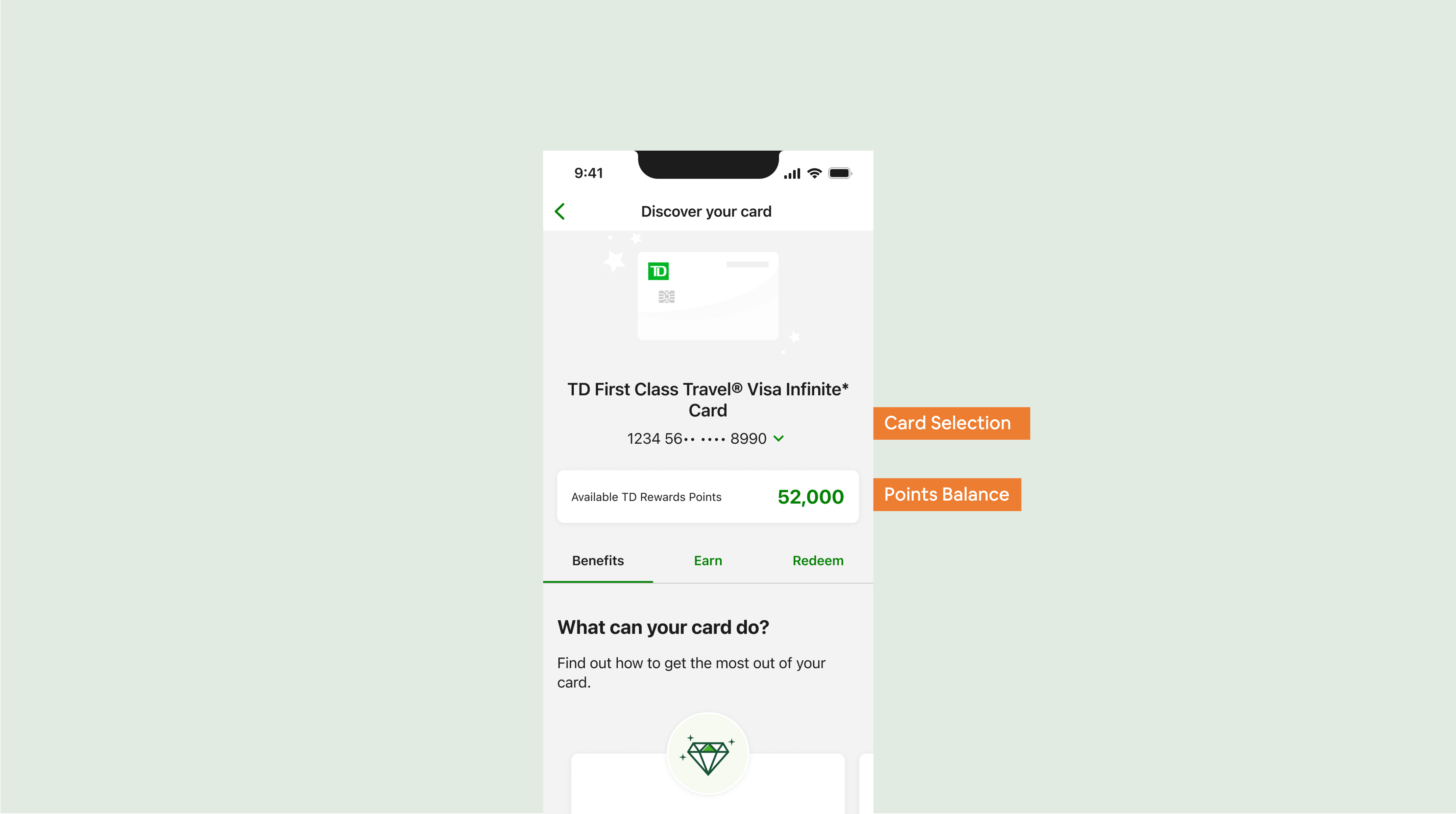
Rejected: Opening directly with educational content (Benefits, Earn, Redeem) without a value anchor. Tested poorly — users engaged less with content when they hadn't first seen what was personally relevant to them.
03
Information architecture
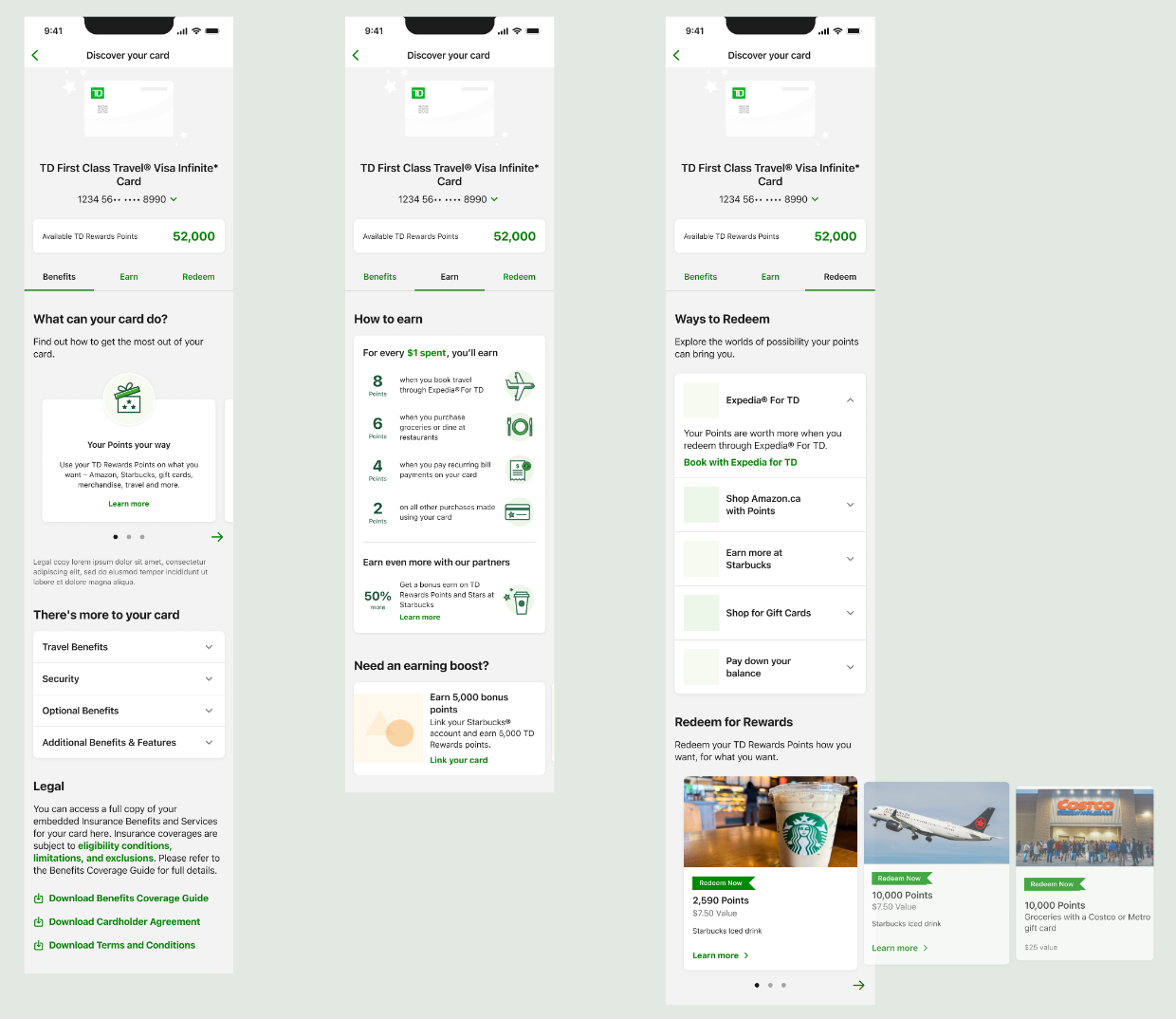
The rewards program has a complex internal taxonomy built around product teams and program categories. Users don't think in those terms. Research showed users approach rewards with three distinct intents: understanding what their card does (Benefits), learning how to accumulate points (Earn), and figuring out how to spend them (Redeem). Organizing the IA around this mental model — rather than the program's internal logic — meant users could find what they were looking for without learning a new system first. Each section ends with an actionable CTA, turning comprehension into behaviour.
Rejected: Organizing by program category (e.g., Travel, Dining, Partners). This reflects how the product team thinks about the program, not how users navigate it. Card program logic isn't a user mental model.
05 — Solution
A centralized hub built around user intent.
The Education Centre is a single, discoverable destination that surfaces what users have, explains the system in plain language, and gives them a clear next step — from any entry point in the app.
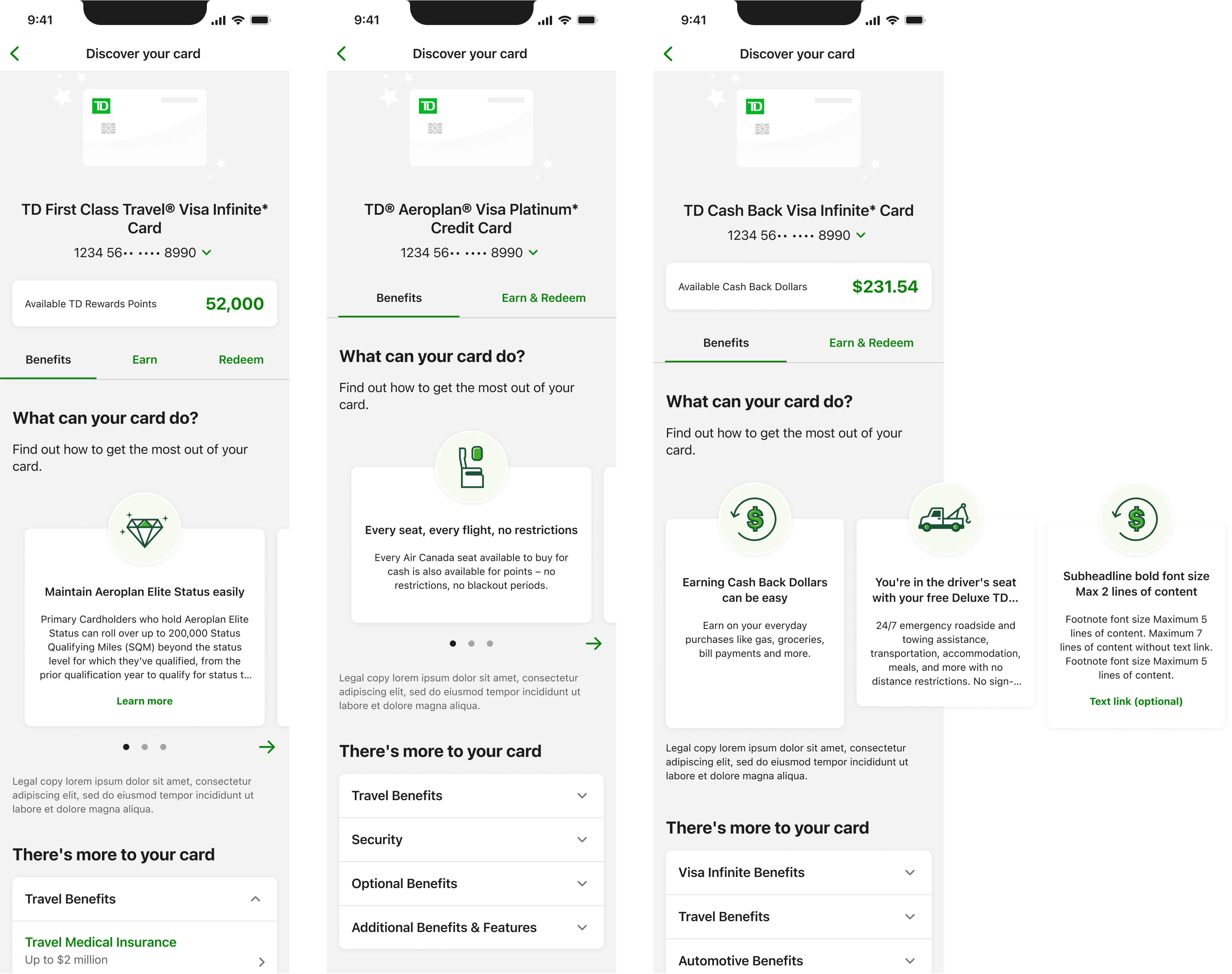
The solution scales across card types: the Benefits, Earn, and Redeem model adapts to different reward structures (points, cashback, travel). For cashback cards, Earn and Redeem are combined into a single section — reducing cognitive overhead without changing the underlying IA.
Information architecture
Education Centre
Benefits
What does this card offer? Answer before users ask.
→ Explore card benefits
Earn
How do I get more points? Make the path to earning legible.
→ Start earning more
Redeem
What can I do with my points? Make value tangible.
→ Redeem your points
06 — Constraints & collaboration
Complexity beyond the screen.
The Education Centre wasn't a solo effort — it required sustained cross-functional coordination across four teams, each with distinct constraints that shaped the final design.
Navigating these constraints wasn't friction to minimize — it was part of the design work. A senior designer's job isn't to hand off specs and wait. It's to hold the thread across all of these surfaces simultaneously.
Product
Worked closely with the PM to align the Education Centre scope within the broader North Star Vision without overbuilding for v1. Maintained weekly sync to keep design, product, and roadmap decisions in lockstep throughout the sprint.
Engineering
The feature depends on multiple backend APIs — card data, points balance, partner feeds, and program content. I defined fallback states and error handling for each API failure scenario, ensuring the UI remained coherent even under partial data conditions.
Design Systems
Worked with the design systems team to ensure the Education Centre used existing component primitives where possible, and flagged new patterns that should be incorporated into the system rather than built as one-offs. Prevented future drift.
Legal & Compliance
Benefits content is legally regulated. I collaborated with the legal team to define what language was permissible, where disclosures were required, and how to communicate program terms accurately without breaking the visual hierarchy or making content unreadable.
07 — Outcomes
Better comprehension. Measurable behaviour change.
Over 65% of cardholders began engaging with the Education Centre after launch — well above the adoption threshold the team had projected. Cardholders expressed satisfaction and reported feeling able to understand and use their rewards for the first time.
The most direct signal came from support: inbound agent calls about credit card rewards dropped by over 40% within the first two months. Cardholders no longer needed to call to understand the basics — the Education Centre answered those questions in the product itself.
The Benefits / Earn / Redeem IA now anchors the broader Loyalty & Rewards redesign. Future features will extend this structure rather than building parallel information architectures.
65%+
User engagement
Of cardholders actively engaged with the Education Centre post-launch — users reported satisfaction and feeling able to understand their rewards for the first time.
40%+
Drop in support calls
Inbound agent calls about credit card rewards fell by over 40% within the first two months — a direct signal that the Education Centre resolved the comprehension gap the product was designed to close.
1
Scalable IA model
Benefits → Earn → Redeem now anchors the broader Loyalty & Rewards redesign, adaptable across points, cashback, and travel reward types.
08 — Reflection
What I'd do differently.
The IA model worked well, but the entry point strategy was designed reactively — defined after the core experience rather than in parallel. In hindsight, discovery and discoverability should be designed together from day one. A feature that users can't find is a feature that doesn't exist.
I'd also push earlier for a content audit before finalizing the IA. The legal review introduced late-stage edits to benefits descriptions that, with earlier involvement, could have shaped the structure rather than constraining it.
What this reinforced.
Cross-functional complexity isn't an obstacle to good design — it's the medium senior designers work in. The decisions that mattered most here weren't visual; they were about what to include, how to structure it, and how to communicate that structure to four different stakeholders with four different concerns.
Design systems alignment also proved its value. Committing to existing components early prevented a proliferation of one-off patterns that would have slowed engineering and created maintenance debt.